Do you want your property leased by a private equity tenant?
As private equity companies, (of which there are currently about 13,143, at the end of 2025 according to keep Pitchbook), keep growing it is critical that buyers and owners understand who in fact the tenants of their buildings are, and if they are private equity companies how it affects the strength of the lease and property valuation.

A common strategy with private equity (PE) companies is to buy a company.
Then they sell the real estate and or create a sale leaseback and pocket the cash and pass it on to the investors or to the PE principals.
Private Equity companies make inroads
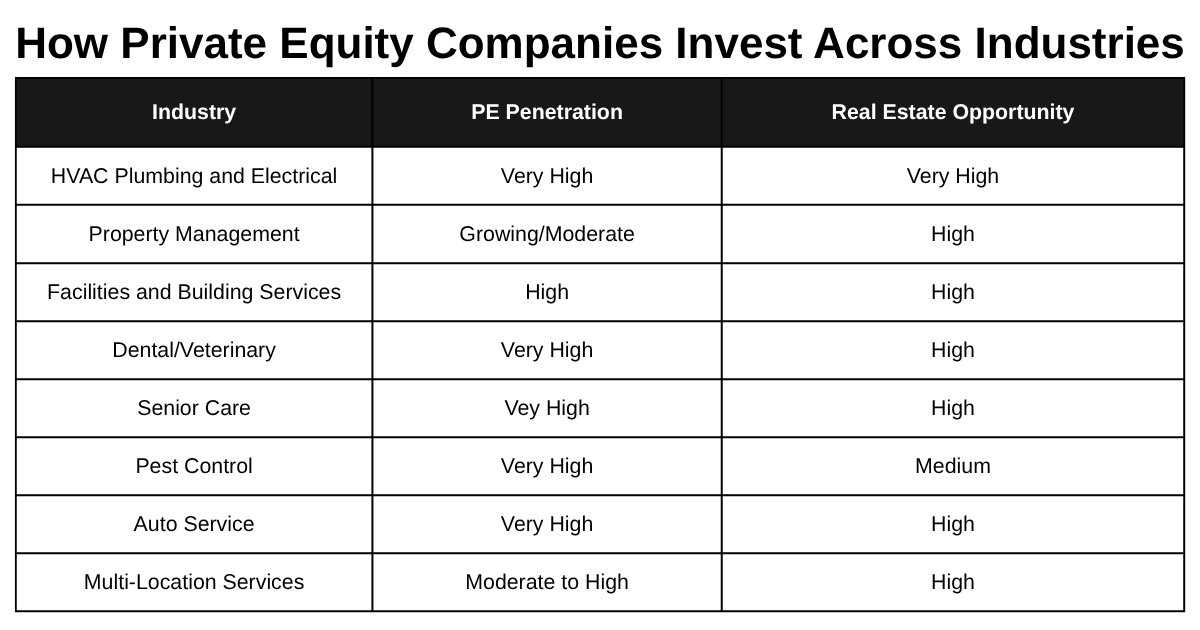
Private equity companies have made significant inroads into ownership of American companies in the United States not necessarily all to the good. A small percentage of the total companies that are owned nationally by private equity investors, but approximately between 5 to 20% are now owned by private equity company’s certain industries especially HVAC, plumbing, electrical, pest control, restoration, security, facilities management and other industries have some significant private equity penetration.
With significant financial backing these companies buy many small companies and roll them together into a national footprint. The benefit to these companies is that they are able to co-brand and create efficiencies through management when it comes to buying supplies and marketing. Owners have been retiring and are looking for an exit strategy, find that private equity buyers tend to pay more than other buyers in the marketplace. That is a significant incentive to sell to private equity.
When we sold our company five years ago, we were approached by private equity investors, and they were willing to pay more than other buyers in the marketplace. We did not choose them because we wanted to merge with a local company whose culture aligned with our corporate culture.
As we create a vision of how this affects the real estate industry we need to consider where the real estate opportunities are for private equity investors. You will see PE companies invest across the business spectrum (see chart below).
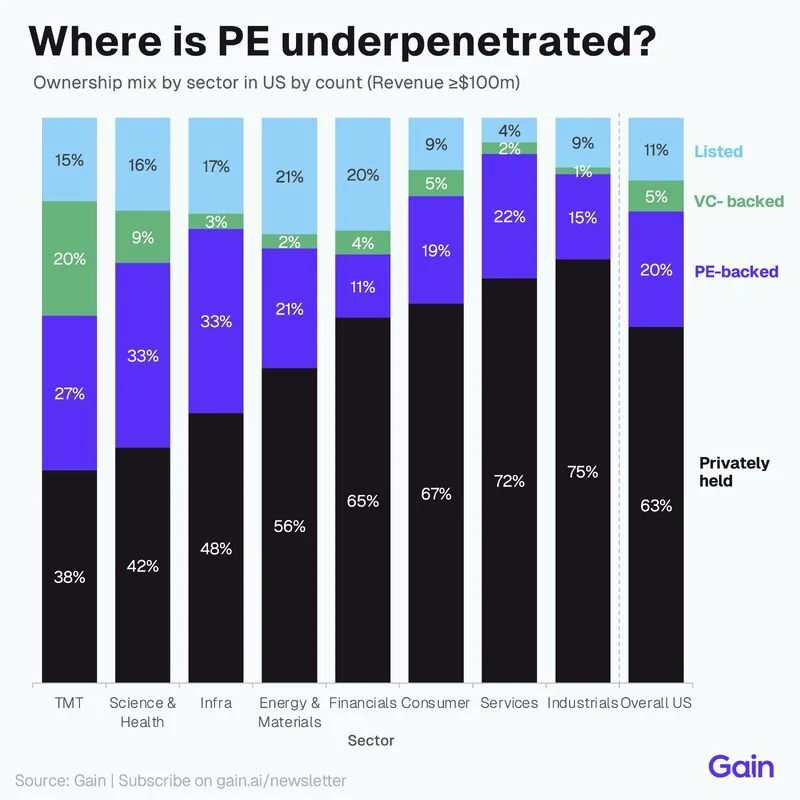
A recent analysis mapping U.S. companies with more than $100 million in revenue by ownership type found that approximately 15% of industrial companies are PE- backed. The same analysis found that about 75% of industrial companies remain privately held.
The Gain company mapped every US company with revenue above $100m by ownership type.
Highest PE penetration is seen in:
Science & Health (33%)
Infrastructure (33%)
Technology, Media and Telecom (27%)
High PE penetration in these sectors reflects resilient cash flows and defensible margins that align with PE’s value creation strategies.
By contrast, PE penetration is lowest in:
Financials (11%)
Industrials (15%)
Consumer (19%)
Services (22%)
How does this affect the average investor?
Private equity companies tend to not hold ownership of the companies they assemble in the mother companies’ name. In other words, they create separate LLC's and shell companies to protect the corpus of private equity investments.
What does this look like:
When a private equity company executes a lease, commercial landlords expect a well-capitalized tenant. However, institutional backing is often a financial illusion. In a typical buyout, PE firms structure acquisitions through isolated holding companies and debt laden subsidiaries to shield their primary investment funds from liability. If the portfolio company fails, the multibillion-dollar parent can walk away cleanly leaving the landlord holding an empty lease with a bankrupt shell entity.
For landlords and real estate asset managers (who buy and lease out properties), reviewing and approving commercial real estate leases, due diligence is critical. PE firms want to protect themselves and their operations as a result their leases are complex and self-serving. Reaching an understanding of the uniqueness of dealing with private equity tenants takes experienced attorney involvement.
These negotiations are especially challenging, because the landlord does not want to lose the tenant or have an empty building and is a weak bargaining position.
Step 1
You have to uncover the true identity structure. Who is the parent company and what is their goal with the purchase of this tenant. Landlords, assert and property managers need to understand what happens when a tenant does not pay that rent.
Step 2
Private equity acquisitions rely on highly leveraged debt. This means that Private Equity has to figure out how to raise money efficiently during the ownership of the
companies they own.
Often there’s the leverage is expressed as a debt to EBITDA ratio a ratio exceeding 5 to 6 X indicates heavy interest obligations that means even a minor revenue dip could force a company to misread payments.
Recent examples of a failed PE venture were Toys-R-Us Pay-Less-ShoeSource and Sears Robuck that were extraordinarily overleveraged and went out of business over the inability to generate the income needed to pay high rents for their stores. The list is long and ties to the experience and skill of the new CEO’s and the money and commitment behind the deals.
https://en.wikipedia.org/wiki/List_of_private_equity_owned_companies_that_have_filed_for_bankruptcy
Risks include a dividend claw back risk where aggressive dividend recapitalizations drain cash reserves leaving the tenant thin on liquidity. Additionally, if the operating tenant owes money back to its parent, in a financial distress scenario, the PE parent may position itself as a secured creditor ahead of the landlords and the landlord’s end up with nothing and a vacant building.
Step 3
Because private equity firms prioritize speed and clean breaks, the traditional lease security is rarely enough to protect a buyer.
It’s difficult to achieve the level of security and guarantees that you would want from a private equity owner. Depending on how strong you are and how important you are to the deal, you can request a higher level of corporate guarantee from the operating parent.
Your other option is to secure an irrevocable letter of credit that will protect your rents in case there’s a Chapter 11 bankruptcy this allows the landlord to draw down missing rents directly from the issuing bank bypassing the bankruptcy court
Lastly you can enforce a good guy clause if the PE firm flatly rejects full corporate guarantee. You can ask for a good guy clause which holds the guarantor personally liable for all rent obligations up to the exact date the property is cleanly surrendered or vacant. Unfortunately, this won’t make you whole on a 10-year lease.
Step 4
Evaluate bankruptcy and exit protections. PE firms’ ultimate goal is to sell out in three to seven years and make a profit. Your lease must protect the landlord against whoever the next buyer is of the company is. Your challenge is to restrict assignment rights and try to manage your bankruptcy exposure.
Conclusion
Clearly you should hire a skilled attorney to protect the lease rights to your buildings. In the future, especially as baby boomers retire and their kids don’t want to own the companies, we expect more companies will be purchased by Private Equity entities and Landlords will have more risk and will need to have better prepared leases.
As a real estate investor having a robust lease in place is critical. Preferably a lease that has been designed to not only operate with today’s tenants but also will function effectively if the property is purchased by a Private Equity company.
Most of us are not prepared for the highly sophisticated dealings we will be facing as we lease or purchase locations with tenants that are part of a Private Equity fund. It behooves us to get prepared now with our current tenants.
Let over 40 years of our business experience shorten your learning curve to profitability. Contact us today!
Clifford A. Hockley is Principal Broker at SVN | Bluestone, as well as the managing member of Cliff Hockley Real Estate Consulting, LLC. As a Certified Property Manager & Designated Managing Broker, Cliff has 42 years of experience in the brokerage and management of Real Estate companies. Bluestone and Hockley Real Estate Services managed condominium associations, multi-family, and commercial properties in the greater Portland area. He was focused on running the company and involved with investment property brokerage. He worked with financial institutions, governmental agencies, private investors, and not for profit organizations. He also has vast knowledge in budgeting, organizational management, and building structures. His previous experience includes over five years in accounting, production supervision for a manufacturing company, and work for state agencies in California.
Cliff grew Bluestone and Hockley Real Estate Services into a 100 employee company that managed over 2 billion dollars of real estate assets before he sold the company in 2021. He also supervised a sales team of over 15 real estate brokers for over 35 years. His monthly newsletter, QuickFacts has over 2,300 subscribers. He has been involved in numerous real estate transactions that include industrial, retail, office, and multifamily properties. Cliff has also written a book called “Successful Real Estate Investing; Invest Wisely, Avoid Costly Mistakes and Make Money” published by Morgan James Publishing in 2019.
Cliff has successfully coached real estate investors and CEOs located throughout the United States since 2015. He has acted as a sounding board to help untangle knotty issues that need an experienced outside opinion. He guides leaders who find it is “lonely at the top” and need an experienced hand to help set a strategic direction, sort out operational problems and want to talk through challenging business decisions.
He has served as an adjunct professor at Portland State University from 2028 – 2021, teaching classes in: Intro to Real Estate, Basic Real Estate Finance, Property Management as well as Real Estate Investment Fundamentals. He has instructed hundreds of students and believes that substantial preparation and active student engagement are crucial for learning and appreciating the field of real estate. Students appreciate his candor and real-world experience.
Among his many civic activities, Cliff served on the Board of Directors for the Portland Chapter of the Institute of Real Estate Management (IREM) and the Rental Housing Alliance of Oregon. In 2014 he was recognized by IREM as board member of the year, and in 2015 he earned an achievement award in brokerage from SVN International. In the years 2000 & 2003, he was recognized by IREM as Certified Property Manager of the Year.