Developing an initial screening to focus on the best candidates to interview and hire
This article provides guidance on effective candidate screening and hiring practices. It emphasizes the importance of having a clear vision of the skills and qualities you are looking for in new hires, and using a structured screening process to identify the best candidates.

It’s always difficult to hire.
You get bombarded with resumes that you need to sort, of which over fifty percent are not qualified for the job, and now you have to parse the other resumes to find the right fit.
First steps include knowing what you are looking for. For example, “a senior employee that can lead and I don’t need to train”, or a person “new to the business that can grow and mature though our ranks”. It helps center you if you have a job description and a competitive wage and benefits offering. Having a good handle on the wages that are being offered in the marketplace will make it easier to recruit.
Wage inflation can make hiring very difficult but should also be a wake-up call to make sure you are paying your team members what they are worth. You want to show your existing staff they are appreciated and are not easily recruited away, then you will also be prepared for what new employees are asking in wage demands.
Promoting from within and training your team to advance also helps, as it gives team members a way to increase their income which makes them not only more valuable but also more likely to stay with you for the longer term.
Candidate screening
As you look over resumes or maybe have AI scan your resumes and rank them, you will want to consider what skills are most important for your new team members to have.
Skills that typically stand out are:
Dependability
Organizational skills
Honesty
Consistency
Great communication skills
Cultural alignment
Skills to do the job
Natural intelligence
Positive action-oriented personality
Curiosity to solve problems
Good references from previous employers
Successful completion of job-related skills test
To help screen those skills we have drafted (with the help of AI of course) a short list of sample questions (see below) to either be sent out as a prescreen or to use in the personal prescreening or interview process. One set of questions can be used for most job positions.
It does make sense to use the same set of questions for all applicants so you can compare responses once you narrow it down to the top two or three candidates. You will want to draft up your own set of questions; the following list is a sample of questions to get your creative juices flowing.
Comprehensive Candidate Screening Questionnaire
1. Dependability & Consistency
Focus: Reliability, punctuality, and maintaining a high standard of work overtime.
Describe a time when you were juggling multiple urgent deadlines. How did you ensure nothing fell through the cracks, and how did you deliver on your promises?
Scenario: You realize a project you are responsible for is going to be late due to unexpected roadblocks. At what point do you notify your supervisor or members of your team, and how do you present the situation?
What does "consistency" mean to you in a daily professional setting, and how do you maintain your energy and focus completing routine tasks during the day?
Do you find your cell phone and texting to be a distracting influence which keeps you from getting projects completed in a timely manner?
2. Organization & Communication Skills
Focus: Time management, clarity, and proactive information sharing.
Walk me through your preferred system or tools for organizing your daily tasks, deadlines, and project notes.
What do you know about artificial intelligence tools and tell me how you recently used them to complete a task.
Tell me about a time you had to explain a complex or highly technical concept to a coworker or client who didn’t share your background. How did you ensure they understood?
How do you prefer to handle asynchronous communication (e.g., email, Slack, project boards) to ensure your team is kept in the loop without causing information overload?
3. Honesty & Ethical Alignment
Focus: Integrity, transparency, and owning up to mistakes.
Scenario: You made a mistake on a report or project that went unnoticed by your supervisor but fixing it now will require extra work or delaying the next step. What do you do?
Can you share an instance where you had to admit to a manager or client that you didn’t know the answer to an important question? How did you handle it?
Can you share an event where you made a mistake and instead of sweeping it under the rug reported it to your supervisor.
Did you have a time where made a mistake that your were unable to correct and you swept it under the rug and hoped it would go away?
4. Cultural Alignment & Job Skills
Focus: Shared values, team chemistry, and technical competency.
What specific aspects of our company values and culture attracted you to this job posting, and how do you see yourself contributing to our team environment?
What is a specific technical skill or industry tool you have mastered recently, and how did you apply it to solve a real-world problem in your last role?
Role-Specific Competency: > Insert industry specific questions regarding the core technical requirement of the job—e.g., “Describe your experience with data analysis tools” or “How do you approach designing a user interface?”
Do you have any questions about our corporate culture that I can clarify for you.
5.Hands on skill test for the job being interviewed for
Typically, a skills test, let us say for an office, accounting or a maintenance person can either be found online or purchased and be used over and over again for consistency purposes. Additionally using the same set of tests for all applicants will help protect you from potential discriminatory litigation.
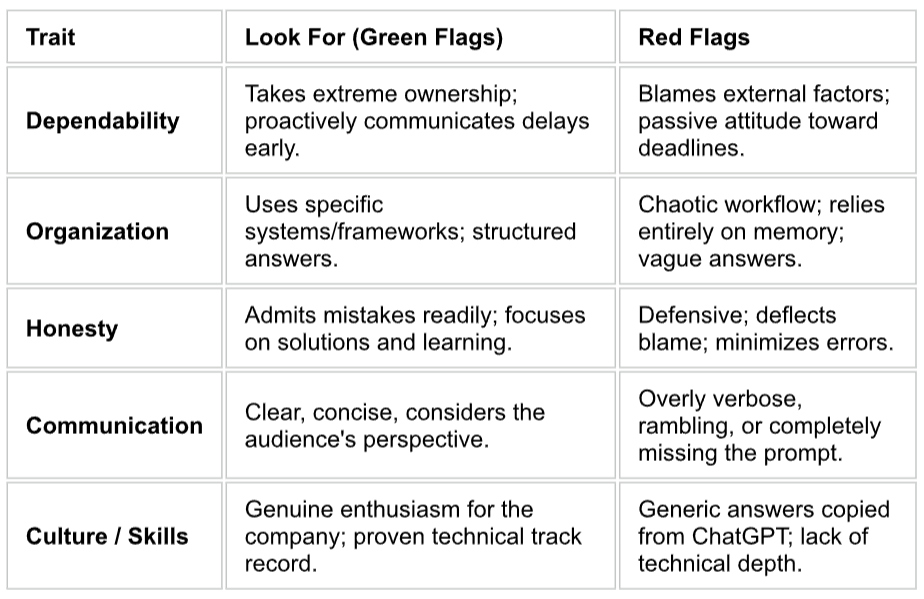
⚙️ Quick-Reference Evaluation Matrix
When reviewing responses, you can score candidates on a simple scale of 1–5 based on these specific indicators:
Summary
Successful hiring involves planning and developing a clear vision of what you are looking for. A realistic job description and budget as well as a competitive benefits package can help you recruit potential candidates, but it’s only the first step.
Taking the time to prescreen and then interview and call references helps you cull out the candidates that would not be a good fit. This then allows you to focus on candidates that are more likely to succeed. Your clear growth vision for the job and your company will come across in the interview and help you hire the best candidates. Hiring the best candidates ensures they will be happy working with you, reducing turnover, and help you meet your growth goals.
Contact us for help building effective candidate screening and hiring practices.
Clifford A. Hockley is Principal Broker at SVN | Bluestone, as well as the managing member of Cliff Hockley Real Estate Consulting, LLC. As a Certified Property Manager & Designated Managing Broker, Cliff has 42 years of experience in the brokerage and management of Real Estate companies. Bluestone and Hockley Real Estate Services managed condominium associations, multi-family, and commercial properties in the greater Portland area. He was focused on running the company and involved with investment property brokerage. He worked with financial institutions, governmental agencies, private investors, and not for profit organizations. He also has vast knowledge in budgeting, organizational management, and building structures. His previous experience includes over five years in accounting, production supervision for a manufacturing company, and work for state agencies in California.
Cliff grew Bluestone and Hockley Real Estate Services into a 100 employee company that managed over 2 billion dollars of real estate assets before he sold the company in 2021. He also supervised a sales team of over 15 real estate brokers for over 35 years. His monthly newsletter, QuickFacts has over 2,300 subscribers. He has been involved in numerous real estate transactions that include industrial, retail, office, and multifamily properties. Cliff has also written a book called “Successful Real Estate Investing; Invest Wisely, Avoid Costly Mistakes and Make Money” published by Morgan James Publishing in 2019.
Cliff has successfully coached real estate investors and CEOs located throughout the United States since 2015. He has acted as a sounding board to help untangle knotty issues that need an experienced outside opinion. He guides leaders who find it is “lonely at the top” and need an experienced hand to help set a strategic direction, sort out operational problems and want to talk through challenging business decisions.
He has served as an adjunct professor at Portland State University from 2028 – 2021, teaching classes in: Intro to Real Estate, Basic Real Estate Finance, Property Management as well as Real Estate Investment Fundamentals. He has instructed hundreds of students and believes that substantial preparation and active student engagement are crucial for learning and appreciating the field of real estate. Students appreciate his candor and real-world experience.
Among his many civic activities, Cliff served on the Board of Directors for the Portland Chapter of the Institute of Real Estate Management (IREM) and the Rental Housing Alliance of Oregon. In 2014 he was recognized by IREM as board member of the year, and in 2015 he earned an achievement award in brokerage from SVN International. In the years 2000 & 2003, he was recognized by IREM as Certified Property Manager of the Year.