Phantom Stock: One Way to Keep an Essential Employee
Summary
This document discusses the challenge of retaining a key employee when company cash flow and growth are uncertain, and direct ownership is not advisable.
It introduces the phantom stock plan as a solution, explaining that it offers employees the financial benefits of ownership without granting voting rights. The plan aligns employee efforts with company goals by granting phantom stock units or a percentage of company value, which can be revalued annually to reflect the employee’s impact and the company’s financial performance.
Key Employee
You are desperate to keep a key employee. You are not sure if you have the annual cash flow to pay for the increased wages to keep that employee. Company growth has been inconsistent. What can you do?
You need this person to think like an owner, but your attorney recommends against sharing direct ownership with them. There is an option for you. Consider a Phantom stock plan.
What is a phantom stock plan?
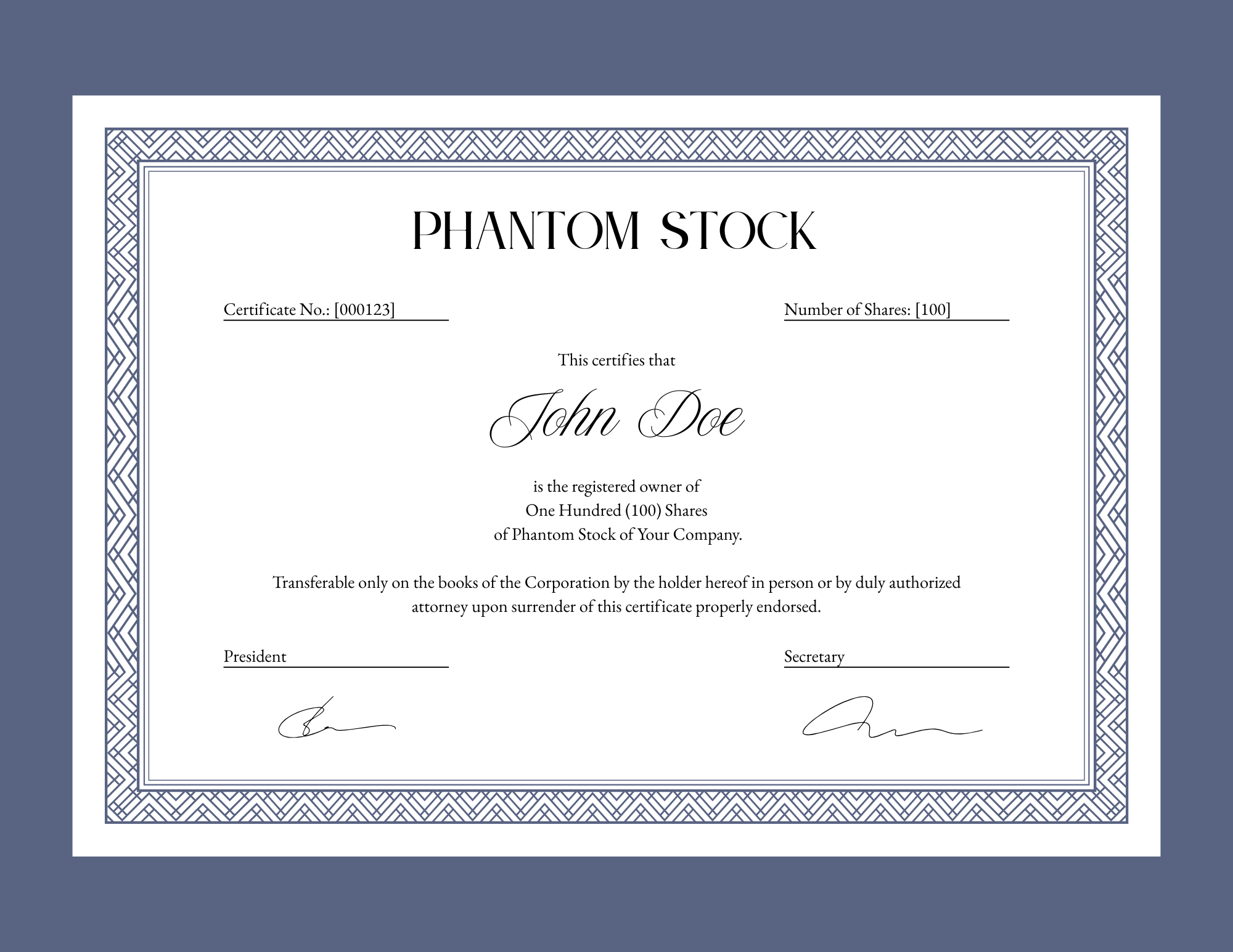
A phantom stock plan, is a written plan that awards an employee the same benefits of ownership with out voting rights. It is considered a long term incentive compensation plan that extends over multiple years and aligns the interests of the employee with those of the owners of the company.
How does a phantom stock plan work?
A company can grant an employee a designated number of phantom stock units or a percentage interest in the company’s value tied into a then current valuation of the company. This valuation can be updated annually so the employee(s) know
They have made an impact
They can see if the company is making more money.. or losing money.
Company goals can be aligned with the employees efforts
For example your company can grant an employee a 5% phantom interest in the company.
And annually you can see if that interest is growing.
You can pay out annually as a type of profit share bonus or you can pay out if and when you sell the company. If you are on track to sell the company in the short term the employee is protected to some extent because if the company sells that get a piece of the pie. It also invents the employee to punch hard to grow the valuation of the company so they get a bigger payout.
If the company is not sold and the employee quits after years of dedicated service, you can work the pay out over time to not burden the company with a large financial hit at one time.
In addition a forfeiture provision can be included in the phantom stock plan to eliminated the obligation to make payments to the key person if they breach non compete components of the plan or employment is terminated for cause.
For example:
We had a key employee work for us. They were employed at an Executive Vice President level. We needed her to help grow the company and implement important initiatives.
We trusted her and she trusted us. To convince her to stay with us we created a plan that gave her a 10% interest of the company. She received annual bonuses equal to 10% of the net revenue we earned (i.e. after all expenses) and when after 20 years of service ( she gave us one year’s notice) we paid her out a 10% of the valuation of the company paid out over 7 years. She was very happy and so were we. To have 20 years of operational stability is an amazing thing to have.
Advantages:
Being an owner of the company is not required for an employee to benefit from company growth.
Phantom shares are an incentive that can be offered without diluting ownership control of company stock
Granting of phantom shares can be tied to performance goals or time served with a company
The phantom shares can potentially be used to help raise the down payment needed to buy an ownership share of the company
Phantom shares are generally not listed as equity on a company’s balance sheet because they represent a contractual obligation of a future cash bonus, instead they are recorded as a liability ( deferred liability or accrued compensation) to reflect the pay out upon vesting or a triggering event. The valuation is adjusted annually as the valuation of the payout either increases or decreases.
Disadvantages:
Holders of Phantom shares do not have voting rights.
Income is taxed as ordinary income rather than at a capital gains rate.
It is not the same as having an ownership say in how the company is run.
It may take time for a company to achieve the valuation goals set by the parties to the agreement especially in a weak economic environment.
If a company is undercapitalized it could take some time to reach growth goals.
Are companies taxed as partnerships when they use phantom stock?
Partnerships and LLC’s to not issue common stock, but they can implement a phantom share/stock plan tied to value of the company rather then share value.
Things to consider.
As an Owner don’t give away the store as you establish the plan. Understand the financial implications of a Phantom share plan on your bottom line. This is a selective plan for one or a couple of employees to tie their interest to the company. For most employee’s a profit sharping and or retirement matching plan would be the way to go.
Owners need to leave room in their decision making to incorporate the addition of outside equity and the potential need to pledge shares for that purpose.
A phantom share plan is a tool Owners can use to preserve key leadership and align their mutual interests. Used carefully and drafted by an attorney and reviewed by a CPA it can help your business grow when you really want to keep a key employee.
Employee problems? Can’t get your department managers to reach their goals? Could your compensation system be part of the problem? Contact us at https://www.chockleyconsulting.com/contact-us
Clifford A. Hockley is Principal Broker at SVN | Bluestone, as well as the managing member of Cliff Hockley Real Estate Consulting, LLC. As a Certified Property Manager & Designated Managing Broker, Cliff has 42 years of experience in the brokerage and management of Real Estate companies. Bluestone and Hockley Real Estate Services managed condominium associations, multi-family, and commercial properties in the greater Portland area. He was focused on running the company and involved with investment property brokerage. He worked with financial institutions, governmental agencies, private investors, and not for profit organizations. He also has vast knowledge in budgeting, organizational management, and building structures. His previous experience includes over five years in accounting, production supervision for a manufacturing company, and work for state agencies in California.
Cliff grew Bluestone and Hockley Real Estate Services into a 100 employee company that managed over 2 billion dollars of real estate assets before he sold the company in 2021. He also supervised a sales team of over 15 real estate brokers for over 35 years. His monthly newsletter, QuickFacts has over 2,300 subscribers. He has been involved in numerous real estate transactions that include industrial, retail, office, and multifamily properties. Cliff has also written a book called “Successful Real Estate Investing; Invest Wisely, Avoid Costly Mistakes and Make Money” published by Morgan James Publishing in 2019.
Cliff has successfully coached real estate investors and CEOs located throughout the United States since 2015. He has acted as a sounding board to help untangle knotty issues that need an experienced outside opinion. He guides leaders who find it is “lonely at the top” and need an experienced hand to help set a strategic direction, sort out operational problems and want to talk through challenging business decisions.
He has served as an adjunct professor at Portland State University from 2028 – 2021, teaching classes in: Intro to Real Estate, Basic Real Estate Finance, Property Management as well as Real Estate Investment Fundamentals. He has instructed hundreds of students and believes that substantial preparation and active student engagement are crucial for learning and appreciating the field of real estate. Students appreciate his candor and real-world experience.
Among his many civic activities, Cliff served on the Board of Directors for the Portland Chapter of the Institute of Real Estate Management (IREM) and the Rental Housing Alliance of Oregon. In 2014 he was recognized by IREM as board member of the year, and in 2015 he earned an achievement award in brokerage from SVN International. In the years 2000 & 2003, he was recognized by IREM as Certified Property Manager of the Year.