Have commercial real estate CAP rates outlived their usefulness?
The article discusses the usefulness of commercial real estate capitalization (CAP) rates as a measure of property value.

For a long time, many real estate brokers and investors have believed that the Capitalization (CAP) Rate was the best indicator of the value of a piece of real estate. I do not agree; I believe that real estate values cannot be boiled down to a simple CAP rate. There are too many variables that need to be considered in establishing a value of commercial in addition to the CAP Rate.
These variables also affect property valuations:
a. Age of building
b. Condition of building
c. Quality of building
a. Concrete Tilt
b. Concrete Block
c. Metal
d. Wood (to name a few)
d. Location
a. Above or below grade
b. In a small town
c. In a metropolitan area
e. Flood plain
f. Length of lease terms
g. Quality of tenants
h. Kind of lease
a. Gross
b. Modified gross
c. NNN
d. Absolute NNN
i. Quality of leases
a. two page homemade lease
b. sophisticated lease
a. candidly the more sophisticated the less risk for the investor
j. Population growth or shrinkage
k. Local regulations (zoning for example)
l. Rent controls
m. Property taxation rules in that submarket
n. Weather patterns
a. fires
b. hurricanes
c. tornadoes
d. flooding
o. Risk of pollution, water, hydrocarbon, other
p. The economy
q. Interest rate variability
r. Potential leasing rates
s. Variable property management fees
t. Tenant improvements
u. Potential future capital retrofits
a. for example:
a. plumbing
b. electrical
c. asphalt
d. roofing
v. Vacancy rates - estimated length of potential vacancies
w. Current market conditions
x. And most importantly does the property cash flow.
Cash Flow
Real estate investments typically gain value in four ways: Debt Reduction, Depreciation Shelter, Appreciation and Cash Flow.
In my mind cash flow is the most important variable when establishing value for a commercial investment property. In simple terms cash flow is derived when property income, minus property expenses minus debt equals cash flow. See a more detailed image below.
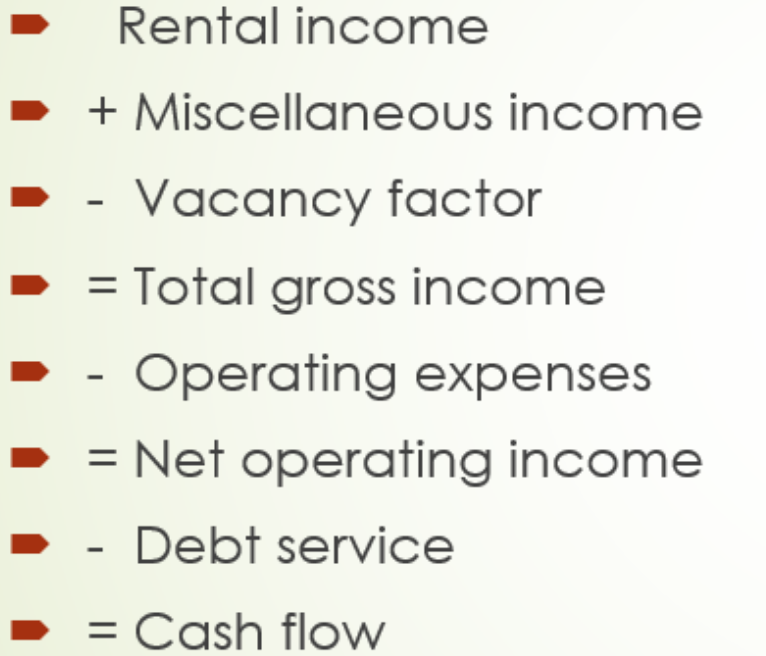
This is a simplified overview. Unfortunately, many properties do not cash flow well enough to buy at this time. Former rules of thumb indicating a positive cash flow of over 5% might make for a reasonable deal, if you included a vacancy rate, property management and reserves into the expense components, but given the variables mentioned above and below this seems to be an oversimplification of value.
This may sound very conservative, but the real estate market is never at stasis. In addition, there are many additional variables we need to consider.
For example:
Rent control for residential properties
Online shopping for retail properties
The massively increasing costs of labor and materials, taxes, utilities and insurance.
The closing of hundreds of retail stores like Advance Auto, Rite Aid, Family Dollar, Macy’s, Pizza Hut, Seven – Eleven, Grocery Outlet and 99 Cents Only are a signal that the tension between online shopping and retail shopping is building.
Clearly competition also plays a role in this picture and it’s hard to have multigenerational growth in any business, without extraordinary leadership. But having a broker tell you that a 10-year lease does not need reserves or a vacancy rate comes from a broker that has never invested in real estate for themselves.
Outdated industrial buildings that cannot accommodate today’s larger trucks have small dock doors, not enough power, built of brick and have only 11 foot clear ceilings.
Interest rate and down payment variability - (with 40% down requests by financial institutions) the concept of leverage has become a weaker part of the real estate investment equation.
Plus, the list above of the other variables in the first list of variables.
Summary
Low CAP rates are being used as a sales tool to entice buyers, but CAP rates are a small part of a larger purchase analysis and should be viewed that way by investors. They are simply indicators of value showing a relationship of Net Operating Income (NOI) to the sales price and cannot be construed to tell the picture of a total real estate deal.
It’s high time for investors to use a more in-depth analysis including the above listed variables and a cashflow analysis review to assess investment risks and the variables that can establish a reasonable sale price.
There are many reasons the vast majority of property sales are stalled, and they boil down to challenging seller expectations and high downpayments required by Lenders and our current interest rate environment. Deals are occurring when the Seller agrees to a significant value write down.
Despite the stronger start to 2026, sales slowed heading into late spring. April 2026 experienced a 33% decline compared to an unusually strong April 2025, highlighting that the market recovery is stabilizing rather than skyrocketing. (1) (see data references below)
For the market to pick up momentum Sellers and Lenders must change their approach to evaluating property values. In the meantime, CAP rates are probably not the best measure to use when estimating a real estate purchase. It seems that the current CAP rate environment may have outlived its usefulness.
In any case overpriced listings and unrealistic CAP rates will not encourage Buyers to pull the trigger. Maybe the time has come for a change in the way we calculate real estate valuations.
(1) The primary references for these statistics include:
MSCI Real Capital Analytics (RCA) – Q1 2026 Capital Trends: Source for the $110.7–$113 billion total investment volume figures and the baseline 18% year- over-year Q1 volume growth. This report also provided the breakdown for the office investment rebound ($20.5 billion, up 39% YoY) and industrial liquidity ($31 billion, up 27% YoY).
CBRE U.S. Capital Markets Figures (Q1 2026): Confirmed the overall surge in commercial real estate investment volume to roughly $117 billion (a 19% YoY baseline increase) and detailed the expansion of inbound cross-border capital (+18%).
CoStar Group / Commercial Repeat-Sale Indices (CCRSI) Q1 2026 Market Report: Source for the value-weighted price indicators, smaller vs. larger property size trends, and sector-by-sector volume distributions (noting the divergence where general commercial volume rose roughly 20%).
Altus Group – U.S. Commercial Real Estate Transaction Analysis (Q1 2026 & Q4 2025): Provided the data regarding shifting median deal sizes, price-per- square-foot benchmarks (e.g., multifamily leading at ~$150/SF), and historical context for full-year 2025 volumes ($560.2 billion baseline).
Mortgage Bankers Association (MBA) Commercial/Multifamily Quarterly Forecast: Source for lending liquidity trends, including the projected 27% increase in commercial mortgage originations ($805 billion total) for 2026.
We can be your resource to increase your revenue by 50%. Contact us for more information!
Clifford A. Hockley is Principal Broker at SVN | Bluestone, as well as the managing member of Cliff Hockley Real Estate Consulting, LLC. As a Certified Property Manager & Designated Managing Broker, Cliff has 42 years of experience in the brokerage and management of Real Estate companies. Bluestone and Hockley Real Estate Services managed condominium associations, multi-family, and commercial properties in the greater Portland area. He was focused on running the company and involved with investment property brokerage. He worked with financial institutions, governmental agencies, private investors, and not for profit organizations. He also has vast knowledge in budgeting, organizational management, and building structures. His previous experience includes over five years in accounting, production supervision for a manufacturing company, and work for state agencies in California.
Cliff grew Bluestone and Hockley Real Estate Services into a 100 employee company that managed over 2 billion dollars of real estate assets before he sold the company in 2021. He also supervised a sales team of over 15 real estate brokers for over 35 years. His monthly newsletter, QuickFacts has over 2,300 subscribers. He has been involved in numerous real estate transactions that include industrial, retail, office, and multifamily properties. Cliff has also written a book called “Successful Real Estate Investing; Invest Wisely, Avoid Costly Mistakes and Make Money” published by Morgan James Publishing in 2019.
Cliff has successfully coached real estate investors and CEOs located throughout the United States since 2015. He has acted as a sounding board to help untangle knotty issues that need an experienced outside opinion. He guides leaders who find it is “lonely at the top” and need an experienced hand to help set a strategic direction, sort out operational problems and want to talk through challenging business decisions.
He has served as an adjunct professor at Portland State University from 2028 – 2021, teaching classes in: Intro to Real Estate, Basic Real Estate Finance, Property Management as well as Real Estate Investment Fundamentals. He has instructed hundreds of students and believes that substantial preparation and active student engagement are crucial for learning and appreciating the field of real estate. Students appreciate his candor and real-world experience.
Among his many civic activities, Cliff served on the Board of Directors for the Portland Chapter of the Institute of Real Estate Management (IREM) and the Rental Housing Alliance of Oregon. In 2014 he was recognized by IREM as board member of the year, and in 2015 he earned an achievement award in brokerage from SVN International. In the years 2000 & 2003, he was recognized by IREM as Certified Property Manager of the Year.