Evaluating Your Property Manager
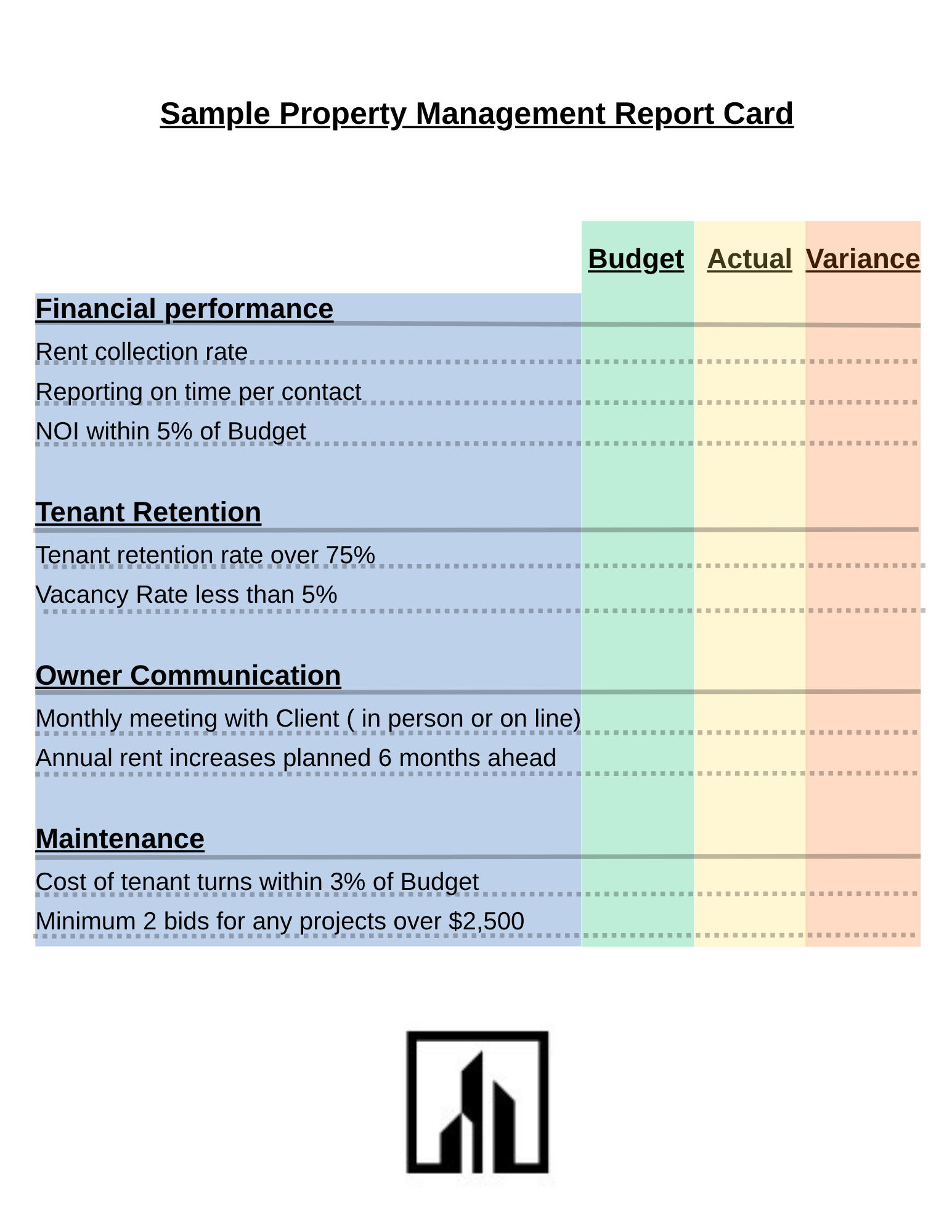
When’s the last time you took a moment to review the successes or failures of your property manager?
Some property managers are excellent, while others leave much to be desired. Just like an employee, you need to understand what your property management company is doing to help you succeed with your investments.
Making Money
The most important thing your property manager can do is help you make money. The challenging question is how to evaluate whether you’re making money or not. Of course, you receive monthly financial statements and checks, but it’s equally important to review your annual income compared to previous years to determine if you’re achieving your expected return on investment.
Financial Reporting
A major step on the trust ladder with your property manager is accurate monthly financial reports. Financial reporting is often the most visible way a property manager communicates with you on a monthly basis. If the reports are inaccurate—because bills from other properties were posted to yours or rents were posted incorrectly—it skews your information flow and makes intelligent decision-making difficult. It also makes you doubt the information being presented.
Every aspect of financial reporting provides a roadmap for tracking the success of your investments. If the reporting is inconsistent, untimely, or inaccurate, your ability to trust your property manager erodes.
Communication
It’s important for property managers to check in with their clients regularly, though the frequency varies by owner. The more assets you have, the more often you need to communicate because there are more moving parts.
Property managers should update you regarding tenant turnover, large expenses, property maintenance, and marketplace changes affecting your property. If your property manager isn’t checking in at least once a month, you’ll find yourself out of touch with your properties and, frankly, you’ll have trouble getting your expected yield. These check-ins can occur by phone, email, online conference call, or through a monthly report cover letter.
Another tricky part of the communication puzzle is the experience level of your contact and their ability to track and complete projects. If your property manager is unable to complete projects on a month-to-month basis and you must review the same items repeatedly at every check-in meeting, they’re the wrong property manager.
Equally important is their ability to make intelligent decisions regarding your property. If they lack experience, they’ll make poor decisions and may guide you toward poor decisions in your property operations.
One more detail to consider is how cost-conscious your property manager is. Your return on investment depends on using cost-effective vendors who deliver quality repairs. If your property manager consistently uses expensive, high-end vendors for all repairs, your cash flow will be depleted. Your property might look pristine, but you’ll be broke. One example: a client who owned a 14-unit property in Maine had two onsite maintenance people. She never had positive cash flow because the maintenance staff invented work. The property looked great, but she didn’t earn enough to pay her retirement bills.
Decision Making
We tend to rely on property managers to help us make decisions regarding our properties because we often don’t live nearby. We expect them to drive by and inspect the property, meet with tenants, and fill in the gaps as we make refinancing, construction, and re-tenanting decisions. If they don’t have the skill to provide sound advice, we’ll make wrong decisions that affect our property’s success. If you don’t have time to meet with your property management team, consider hiring an asset manager to help you get the job done.
Marketing
If the property manager and their team are responsible for marketing the property for lease or sale, ensure they have the skill and staff to create visibility for your property and secure the best lease rate or sales price. For apartments, this means staying in touch with the marketplace and vacancy rates to adjust rents appropriately and minimize vacancies. This requires a level of sophistication and experience that should be part of your evaluation process.
Summary
As you can see, managing a property manager takes time and thoughtfulness. You cannot assume they’re doing a good job simply because they’re the biggest firm with the most certifications, or the smallest mom-and-pop company offering more personal attention.
There are a few key people you should communicate with regularly when working with a property manager: the owner, the department head, the accountant, and the day-to-day person caring for your investment. If there’s constant employee turnover and you cannot achieve the business stability you need, that’s a good reason to switch to another property management company.
It makes sense to have at least one annual goal-planning meeting with your property manager to review your properties’ performance and set goals for the coming year. If you have large investments, you may need to meet monthly to keep everything on track.
Finally, it’s difficult to switch from one property manager to another, but if you’re not comfortable with the results your property manager is delivering, you need to tell them you’re considering making a change if your concerns aren’t addressed.
Clifford A. Hockley is Principal Broker at SVN | Bluestone, as well as the managing member of Cliff Hockley Real Estate Consulting, LLC. As a Certified Property Manager & Designated Managing Broker, Cliff has 42 years of experience in the brokerage and management of Real Estate companies. Bluestone and Hockley Real Estate Services managed condominium associations, multi-family, and commercial properties in the greater Portland area. He was focused on running the company and involved with investment property brokerage. He worked with financial institutions, governmental agencies, private investors, and not for profit organizations. He also has vast knowledge in budgeting, organizational management, and building structures. His previous experience includes over five years in accounting, production supervision for a manufacturing company, and work for state agencies in California.
Cliff grew Bluestone and Hockley Real Estate Services into a 100 employee company that managed over 2 billion dollars of real estate assets before he sold the company in 2021. He also supervised a sales team of over 15 real estate brokers for over 35 years. His monthly newsletter, QuickFacts has over 2,300 subscribers. He has been involved in numerous real estate transactions that include industrial, retail, office, and multifamily properties. Cliff has also written a book called “Successful Real Estate Investing; Invest Wisely, Avoid Costly Mistakes and Make Money” published by Morgan James Publishing in 2019.
Cliff has successfully coached real estate investors and CEOs located throughout the United States since 2015. He has acted as a sounding board to help untangle knotty issues that need an experienced outside opinion. He guides leaders who find it is “lonely at the top” and need an experienced hand to help set a strategic direction, sort out operational problems and want to talk through challenging business decisions.
He has served as an adjunct professor at Portland State University from 2028 – 2021, teaching classes in: Intro to Real Estate, Basic Real Estate Finance, Property Management as well as Real Estate Investment Fundamentals. He has instructed hundreds of students and believes that substantial preparation and active student engagement are crucial for learning and appreciating the field of real estate. Students appreciate his candor and real-world experience.
Among his many civic activities, Cliff served on the Board of Directors for the Portland Chapter of the Institute of Real Estate Management (IREM) and the Rental Housing Alliance of Oregon. In 2014 he was recognized by IREM as board member of the year, and in 2015 he earned an achievement award in brokerage from SVN International. In the years 2000 & 2003, he was recognized by IREM as Certified Property Manager of the Year.